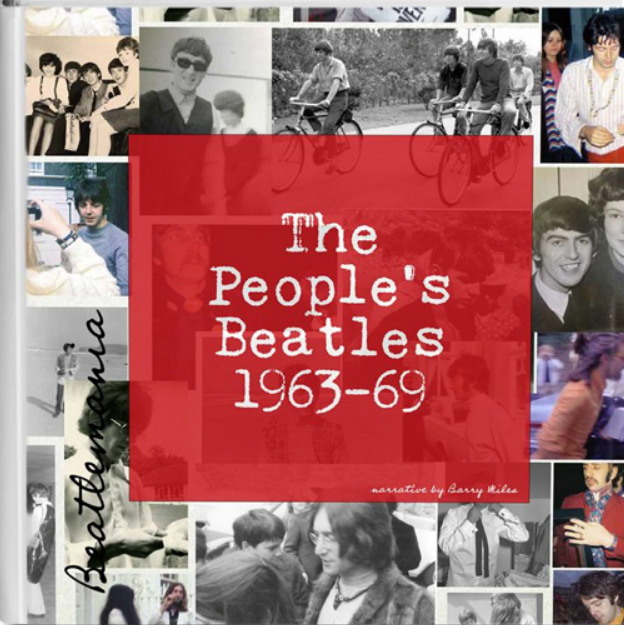
This is a very difficult book to find and/or locate for one’s collection. The people that put the book together solicited fan photos taken between 1963 and 1969. The book was published by Photobox and long-time Beatles associate, Barry Miles, provided much of the narration for the book.
The title was only available to purchase for a very short time and then was no longer being offered for sale. Apparently, the reason it was no longer available was administrative reasons and several people who had contributed photos for the book had not been properly credited.
I was able to find a copy of the book by contacting a gentleman who had contributed photos to the book and had not been credited for their use. Always will be grateful to you, Mr. R. Kern!
There are many wonderful photos of the Beatles in this book capturing the personal nature of fan photography, not being posed for! It is in my opinion, a shame that the book was not allowed to have a much wider circulation.
Beatle fans were amazed at the music and dialog that was featured in the Peter Jackson Get Back project. This provided nearly 8 hours of wonderful music and dialogue which altered the perceptions of many concerning the group’s demise. Much of the audio that appears in the Get Back film was sourced from something called the Nagra Reels, used to source film shot with the respective audio that matched.
This book- THE BEATLES In The Studio With The Beatles – Nagra Tapes published in 2009 in both Dutch and English was written by author Dennis Dekker.
It is a 134-page hardback book and was edited by Henk-Jan Hoekjen and translated into English by Pien Steffes. Dekker was able to listen to the Nagra reels and was able to transcribe many of the conversations. Though he lacked the technical advances available to Peter Jackson, the book represents one of the first attempts to give a fuller picture of what actually transpired at the Get Back sessions. The Nagra reels story itself is fascinating to read about as apparently, they were stolen from the Beatles and were discovered/recovered in a police raid held in the Netherlands in 2021.
What happened the day after The Beatles’ Ed Sullivan Show debut? All the young lads across America met their buddies at lunch and excitedly talked about learning to play guitar! Where could they learn chords? Where do they find such instruments? Coincidently, their own The Beatles Guitar was already in the works!
The Beatles Guitar
Mastro Industries manufactured five different Beatles guitars/ukuleles – plus variations and display models in the U.S. in the Sixties (the Selcol company produced seven other Beatles guitars in the U.K.) Also manufactured about this time was an unlicensed 5″ model made in Hong Kong
Beatle-ist – 30½”
Yeah Yeah – 22″
Four Pop – 21″
Beatles Jr. – 14¼”
Mini – 5½”
“In March of 1964, Maestro Industries, Inc. introduced the Beatles line at the Toy Show in New York. This line included four-string guitars, six-string guitars, plastic bongo drums, and plastic banjos. In 1965, the available line of plastic instruments included various guitars, ukuleles, wind instruments, and percussion instruments, and productions and introductions of new variations continued for a few years thereafter.” – French American Reeds, Inc. – History (2020).
The Beatle-ist Guitar
Mass-produced by Mastro in 1964, the ‘Beatle-ist’ plastic six-string guitar was pink and burgundy, 30½” long, and covered with the band’s faces, names, and autographs on the front of the body. The front of this version read “The BEATLES – Beatle-ist Guitar,” shrink-wrapped and packaged on a backing card with a pick, instruction booklet, and a strap. The instrument came with three colored nylon and three wound strings, labeled in Mastro’s catalog as “No. 340.” They were packaged six to a shipping box as a 21″ x32″ x12″ unit weighing 18 lbs. Mastro also produced another version in orange and burgundy. There was an advertised promo version “with highlighted faces,” but one hasn’t turned up yet.
Another guitar produced by Mastro was the ‘Yeah Yeah’ six-string guitar. It was red and burgundy, 22″ long, and came with the Beatles’ title, faces, and autographs on the body (their faces on the crown.) Earlier promotional versions had the faces printed “highlighted” on a white background. Initially sold shrink-wrapped to a sealed backing card with a pick and instruction booklet, the original retail price doubled that of the “Four Pop” ukulele. The instrument came with six nylon-colored strings and was labeled in Mastro’s catalog as “No. 330.” They were packaged twelve to a shipping box as a 17″ x16″ x24″ unit weighing 14 lbs.
Mastro Beatles Guitar
The Beatles Guitar/ Ukulele
Another design by Mastro was the ‘Four Pop’ four-string plastic guitar/ukulele. It was 21″ long with a red and pink body, three colored nylon strings, and one wound string. This version also came in orange and red. It had the band’s faces on the front and guitar head and autographs on the body, and it came shrink-wrapped on a backing board with a red toy pick, an instruction/songbook, and a strap with “Made in the U.S.A. Under License” printed in black. Some designs included “Four Pop” or “FOUR POP” written on the body. A scarce promo version of the ‘Four Pop’ guitar exists. It had a red body and a burgundy neck with Beatles images on the headstock. This design was sold in shops for a short period before they switched to the more familiar red body and pink neck style. The “Four Pop” was labeled in Mastro’s catalog as “No. 320″ and packaged twelve to a shipping box as a 16″ x16″ x23” unit weighing 14 lbs.
“We made so many ukuleles and the Ringo bongo drum. The ukulele had pictures of the Beatles’ four heads on the top. That period was something else. We sold so many instruments.” – Maria Maccaferri (The Ukulele Occasional)
The Junior Four-String
The ‘Junior’ four-string (3 colored nylon and one wound string) plastic guitar/ukulele was 14¼” in length. It came in three color combinations. One version was pink and burgundy, with another being orange and red (with a small and large graphic of Beatles pictured on the body and crown/head with a 9¾” scale). A third version was a red and maroon promotional display version.
The item had “Jr. Guitar” printed on the front, was packaged on a colorful sealed backing card/board, and included a pick and an instruction booklet/songbook with “Made in U.S.A. Under License” printed in black. There were two variations: the headshots were small, and the other headshots were more significant. The “Junior” was labeled in Mastro’s catalog as “No. 300″ and packaged twenty-four to a shipping box as a 16″ x11″ x16” unit weighing 26 lbs.
“Because of the plastic used [they had] developed a kind of partnership with Dow Chemicals in order to find the best “resonating” polystyrene. The best one they called “Styron.” All the ukes were made in Styron.” – Antoine Carolus (UkeHeidi)
Mastro Advert
Mastro also made “Pin-Up” guitar brooches. Each of these measured 5½” in length. These little plastic pink guitars (with two rubber bands as ‘strings’) were produced with a small hook in the back (lapel clip) for fans to wear as pins. Mastro made two slightly different versions, one with a blue silkscreen-type print and one with dark pink. They had Beatle faces and first-name autographs on the front. The display card for the pins measured 10”x10” and held 12 guitars. It also had a Beatle image on it. There were also some shipping boxes that you could transform/fold into a countertop display.
The NEMS Agreement
The NEMS agreement was with Selcol Products Limited, 114-116, Charing Cross Road, London, W. C. 2. The date of the agreement for the manufacturing license was December 16, 1963, for the ‘different types of guitars.’ Selcol then sub-licensed the guitars to Mastro in the U.S. for manufacturing. Selcol, in the U.K., was an associate company of The Selmer Company, which made plastic toys and garden furniture. In 1968, Selcol Plastics closed.
Find out more about this guitar and Beatles memorabilia in Terry’s excellent book:
NEMS and the Business of Selling Beatles Merchandise in the U.S. 1964-1966 (2ND EDITION)
The book covers the approximately 150 licensed items that dotted store shelves and helped fuel the band-crazed fan during the time right after the band landed in America and performed on The Ed Sullivan Show. Toys, games, dolls, jewelry, clothing, wigs, and more!
In 2012, a wonderful boxset of only 350 copies was issued of 5 large and beautiful Yellow Submarine full color prints along with a special book written by The Simpsons writer and producer, Josh Weinstein. Josh’s essay was entitled “Yellow Subversion.”
The ultimate paradox with sets like this is that their rarity makes them very special and valuable to the collector, yet often they are out of reach financially to others who may wish to enjoy them. This item is very large, and you certainly will not be able to store it on your bookshelf, but the enclosed prints would be wonderful to frame.
There were only 350 numbered copies of the black covered limited edition book which featured images of the Beatles 1964 tour taken by photographer Joe Allen and the book was edited by Mark Naboshek. The book was entitled “The Beatles Monochrome,” and was published in 2011 by Rufus Stone Publishers!
The book was presented in a black slipcase with 4 giclee color photoprints. The limited edition book came in a metal container as shown below. What is not commonly known is that Rufus Stone also published a limited edition version of the book that was bound in white leather and only 10 numbered copies were made of that version of the book. Below are my photos of copy #9 of this beautiful photography book which I recently acquired.
In the latest excerpt from Tony Broadbent’s book The One After 9:09, Tony looks at the great change from Pete Best to Ringo. Did Paul and John drive to meet Ringo?
August 16 – Thursday | In the early hours of the morning John and Paul drive across country to Butlin’s Holiday Camp, in Skegness, to recruit Ringo Starr | Meanwhile, mid-morning at the NEMS office, Whitechapel, Liverpool, by request of the three other Beatles; and quite without warning; Brian Epstein sacks Pete Best from the group | Not The Beatles’ finest hour; and only understandable in the light John, Paul, and George all thought that if they didn’t act—and get a different drummer—they’d lose their hard-won Parlophone recording contract.
£25 a Week
| Ringo agrees to join The Beatles—for £25 per week—but elects to play on with Rory Storm and The Hurricanes until the weekend | That evening Johnny ‘Hutch’ Hutchinson, of The Big Three, is drafted in as drummer for The Beatles’ scheduled gig at the prestigious Riverpark Ballroom, Chester.
PAUL McCARTNEY pressed his foot down hard on the accelerator and, wheels spinning, tyres screeching, his ‘new’ Goodward-green Ford Consul Classic shot forward from the traffic lights. There wasn’t a minute to lose. He and John had left Liverpool at the crack of dawn to make the 160-mile journey, across country, to the seaside resort of Skegness. Only this was no pleasure trip, but a rescue mission. To rescue themselves, their group, and the recording contract that was almost certainly now within their grasp.
Off to Butlin’s
The sole reason they were speeding to the Butlin’s Holiday Camp, located on the east coast of England, to pick up Ringo Starr. And once they’d got both him and his drums packed safely inside the car and the trunk, they’d turn right round again and make the long journey back home.
Paul had decided not to go via Manchester and Sheffield, but opted instead for the more southerly route through Warrington, Stockport, and Chesterfield, before finally making for Lincoln and Skegness. “It’ll be much faster that way. Less traffic.”
Thermos Flask?
“The speed you drive, Paul, I’m surprised we’re not already meeting ourselves coming back. Just get us there in one piece, will yer?” John yawned and poured himself another cup of coffee from the Thermos flask Paul’s dad had given them. “Incidentally, your dad could’ve put some bloody milk in here,” sniffed John. “It’s just like that Nazi crap we drank in Hamburg.”
“Well if you’d just like to step outside the car and get yourself some, John, I’ll be back this way in about five or six hours.”
“Ha, bloody, ha, but no complaints, it’ll do till we get there. Anyroad, I’m just really glad Ringo said, yes, to our ‘Eppy’.”
“Me, too, as it’s clear Pete can’t help get us where we’re going to.” Paul glanced over at his friend. “So, you’re okay with it, now, John?”
“What? The coffee?”
“No, dafty, what we’re doing now…dumping Pete for Ringo.”
“Yeah, I am.” John nodded. “But only because of the group, Pauly, nowt else. You’ve always got to think of the group, first. That’s what I did when I first met you. You could play better than me, so I didn’t hesitate, the group was that much stronger with you in it.”
Paul nodded and smiled. “I’m glad you did, Mr Lennon. Only, that’s what our George has been on about, all this time, isn’t it?”
“Yeah, it is. I thought he was a right drag, going on and on about it, at first, but after both Decca and EMI, well, I changed my mind.”
“Funny, our George, then George Martin coming to the same conclusion…both pushing for a change so the group could sound better.”
Us Being Better
“But that’s it, Pauly, us being better as a group. We’ve always got to do that, you and me, or what’s the bloody point? Just playing the same old things, the same old way, would get us nowhere. It’d kill me, for sure. Kill us, too. And that’s not what it means to be a Beatle.”
“It’s like when we write our songs…always trying to make them better than the last one…then trying to make them better each time we play them. Like that harmonica piece you worked out on, ‘Love Me Do’. It made the song sound so…so much better…real bluesy, like.”
“That was from me listening to that Delbert Clinton play harmonica for Bruce Channel. What a terrific bloke. He showed me some real nice licks on the harp. That’s what I mean, you see, it’s always searching for what’ll make what’s good sound that much better.”
Paul ripped right into ‘Searchin’—the root of anything and everything good yet to come.
John started in on ‘One After 909’—one of the first songs he’d ever written that he’d thought was any good.
Paul joined in—right on track—harmonising—seamlessly.
Paul laughed. “Right, then, you bugger, now one of mine.” And then he lit straight into ‘I Saw Her Standing There’.
John nodded, imagined, reached for new and different notes, and harmonised in fourths, as Paul sang in fifths. It sounded great. They both nodded, then. Yeah, that’s a real keeper.
And that’s how they went on for miles and miles. The two of them singing and laughing and joking and thinking and smoking and chatting—in between challenging each other with their favourite songs. Some of which they’d written together.