By: Shelley L. Germeaux, July 17, 2026
In honor of the 250th anniversary of Independence Day in America, this article is about John Lennon’s American dream, his faith in this country and all it stood for. Despite being born and raised in Liverpool, England, he fell in love with America and wanted to live here. Unfortunately, he faced monumental legal struggles in the early 1970s to stay here because of his outspoken political views against the Vietnam war, and the Nixon administration wanted to silence him. In the end, justice and freedom won out through John’s patience, and the determination of his lawyer Leon Wildes.
The minute John Lennon moved to New York City in the summer of 1971 with his wife Yoko Ono, he instantly felt at home. In his exhilaration, he wanted to become an American citizen. However, it took a ridiculous four years of legal battling to get permanent residency status in the U.S. The U.S. government used every legal means to deport him, rather than welcome the former Beatle with open arms. It was an incredibly stressful time for Lennon, who at times was in fear for his life.
John was much beloved as the founder of the Beatles with millions of devoted fans. So why was the government working so hard to kick him out? The secret corrupt political war against Lennon would eventually be revealed, through author Jon Wiener’s 15-year legal battle to get records via the Freedom of Information Act. Wiener’s 1999 book, Gimme Some Truth, outlines his exhaustive effort to get these records, over one hundred pages of which are included in the book. [i] What he uncovered was shocking.
John’s love of America
John was completely wowed by America the first time The Beatles flew across the Atlantic to New York in February of 1964. He told reporter Larry Kane during that tour, “I think it’s marvelous, especially places like New York and Hollywood. I especially like the big places, the big cities, where the people are, where life is.” [ii]
Lennon had been against the Vietnam war as early as 1965, and to manager Brian Epstein’s dismay, he would be the first major celebrity to publicly voice his concerns about it. Larry Kane recalled John’s disgust when he joined the military in 1966 and showed up with his military haircut. He said John completely bristled and reddened. To John, serving in the U.S. military meant supporting the war, and Kane said they argued about it for an entire plane flight.[iii]
May Pang recalled in her 1983 book Loving John: The Untold Story, that John and Yoko went back to Manhattan shortly after they were married, in December of 1970. Yoko had lived there many years and knew it like the back of her hand. It was exciting, and John proclaimed to the co-founder of Rolling Stone magazine, Jann Wenner, “America is where it’s at. You know, I should have been born in New York, man. Why wasn’t I born there?” He continued, “I regret profoundly not being an American and not being born in Greenwich Village.” [iv]
Move to New York, summer of 1971
Within a few months that dream would start to become reality. John and Yoko abruptly moved to New York on August 13, 1971, [v] after Lennon’s album Imagine was recorded at Tittenhurst Park in Ascot, England. They were frantically searching for Yoko’s daughter, Kyoko, whom Tony Cox, her first husband, had disappeared with. They were given temporary visas, and after lengthy stays in various hotels, they finally settled in a flat at 105 Bank Street in the West Village. It was a bohemian lifestyle that offered a level of freedom John hadn’t known since his early days in Liverpool.
John and Yoko instantly found themselves in the company of the notorious leftist radicals of the time, Bobby Seale, Jerry Rubin and Abbie Hoffman.[vi] They were active anti-war protesters who were involved with the violent riots at the 1968 Republican Convention. Jerry and Abbie had co-founded the Yippee movement and were members of the “Chicago Seven.” Bobby Seale founded the Black Panthers. They befriended Lennon the minute he got to New York, because of his celebrity power; he offered a big name to front their protests and radical movements against the Vietnam War and gain followers. The Lennons always made it clear to them that they were against violence.
John and Yoko brought their beliefs to light when they were given the amazing opportunity to host the Mike Douglas Show in February of 1972, for five days.[vii] The popular mainstream show brought their counterculture ideas directly into American households; they discussed women’s liberation and the peace movement, and performed with Chuck Berry, one of John’s rock n’ roll heroes. Jerry Rubin and Bobby Seale also made guest appearances and talked about anti-war efforts.
A set of five VHS tapes of these full episodes, with a book, was sold by Rhino in 1998. While long out of print, fans can still get this set on eBay. On October 9, 2024, John’s birthday, Daytime Revolution[viii] was released, a 108-minute documentary including the best scenes from these episodes. The footage was cleaned up using current technology, making this a must-have for fans; it is available in current streaming formats and on DVD at Amazon.
Director Erik Nelson said the shows, which reached forty million viewers, virtually “wrecked” John’s life, saying, “Unfortunately, he picked maybe the worst time possible to be that political” as it coincided with Nixon’s campaign for re-election in 1972. “This was seen correctly, I think, by the Nixon administration as a huge threat.” [ix] Since the voting age had just been reduced to eighteen, Nixon knew Lennon’s influence on that age group could cost him the election. After the shows aired, the administration, who had already been taking note of his activities, declared war on John Lennon.
John’s attorney, Leon Wildes published the 2016 book, John Lennon vs. the USA: The Inside Story of the Most Bitterly Contested and Influential Deportation Case in United States History, writing in the Introduction, “From that point on, the Nixon administration made life intolerable for John Lennon and Yoko Ono….I had never seen the government so determined to remove anyone from the United States. Every effort I made was thwarted in a relentless process to deport them as quickly as possible.”
The FBI files document their efforts to surveil him, proving what John had suspected, and openly discussed during his appearance on ABC’s The Dick Cavett Show, May 11, 1972.[x] At the time, this seemed ridiculous to most people. John was a rock musician, not some kind of mafia boss or wanted criminal. He was vocal about his beliefs, but those beliefs were widely held; the idea that the government was actively surveilling him seemed preposterous. No one but him took it seriously, but eventually it turned out that he was correct.
The following month, in June of 1972, he released the double album Sometime in New York City [xi] with the Plastic Ono Band, backed by Elephant’s Memory. It included both live and studio recordings. The album would go down in history as his most political, including songs like “Luck O’ the Irish”, about the conflict in Northern Ireland, as well as “Sunday Bloody Sunday.” “Attica State” relayed the conditions at Attica State Prison, and “John Sinclair” was about a guy who was jailed for pot possession. “Woman is the Nigger of the World” was about how men tended to treat women, triggering a lot of controversy and accusations of racism; but John explained that women had been kept “down” for so long that they felt like slaves. “New York City” was an upbeat song reflecting his love of his new home.
The critical reception of the album was dismal. The harsh, politically charged songs were a hard pill to swallow for his fans, and this depressed John a great deal. About this time, Geraldo Rivera approached the Lennons on the appalling conditions at Willowbrook State School, a facility on Staten Island that housed children with disabilities. John and Yoko were moved by the situation and wanted to help. They agreed to do two One to One benefit concerts at Madison Square Garden on August 30, 1972.
The shows raised over $1.5 million and led to major legislative reform for individuals with intellectual and developmental disabilities. They were the only full-length live concerts John Lennon performed after the break-up of the Beatles. The shows were memorialized in a 2024 documentary entitled One to One. In 2026, the film Power to the People had a limited theatrical release as a follow up to the October 2025 box set, Power to the People: Live at the One to One Concert. The box set comes in multiple formats and price levels.
In addition, documentaries LENNONYC (2010) and The U.S. vs John Lennon (2006) provide further insight into his years in New York.
Nixon won re-election at the end of 1972, to the Lennons’ dismay, and his administration kept their thumb on Lennon’s situation. On March 23, 1973, the judge declared him an “excludable alien” due to his 1968 drug conviction in England. [xii] Despite the revelation that the substance was planted by a corrupt police officer, John had been advised at the time to plead guilty and pay a fine. So, the guilty admission overruled the faulty conviction. The Lennons were applying for permanent residence, but these applications were repeatedly ignored.
Yoko Ono was fine to stay, after having lived in New York for so many years, but Lennon was ordered to leave the country. Lennon appealed this decision, but on July 10, 1974, the decision was upheld and John was ordered to leave the country by September 10. This order was also appealed by Lennon. Interestingly, because of the Watergate scandal, President Nixon resigned from office in disgrace on August 9, 1974.
The strain on John and Yoko’s marriage during this ordeal was such that they separated for eighteen months. John took their assistant May Pang to Los Angeles for a long “lost weekend” and then back to New York City where they shared an apartment by the East River. This apartment was where they saw a UFO, and where John was photographed by Bob Gruen wearing his New York City T-shirt. May Pang’s story was released in her books Loving John: The Untold Story (1983), (long out of print but used copies can be purchased on eBay), Instamatic Karma(2008), and a documentary, The Lost Weekend: A Love Story (2022), available as a DVD and on streaming services.
This relationship was much more than an affair. Her story is a unique one, as she benefited John’s life in many ways. He did go on some unfortunate drinking benders in L.A., but she helped him during his work on the 1973 album Mind Games and was coordinator on his 1974 album Walls and Bridges, contributing background vocals on “9 Dream.” The song “Surprise, Surprise (Sweet Bird of Paradox)” was inspired by her. Both albums were met with critical success. She encouraged the reunion with his son Julian, as well as the other Beatles, not to mention countless other musicians like Harry Nillson, Mick Jagger and Elton John.
They seemed very happy, that is, until the end of January 1975, when May recalled many urgent phone calls from Yoko. Heated arguments ensued, causing John to slam the phone down. May knew something was very wrong, but he assured her things were fine. To her shock, John suddenly left for the Dakota during the first week of February 1975 without explanation and didn’t come back, except to pack his things. Communications after that were cryptic and confusing.
Ironically, his departure coincided precisely with the commencement of the lawsuit with Morris Levy, as explained in the 2022 book by Jay Bergen, Lennon, the Mobster and the Lawyer.[xiii] This was over a copyright infringement case that was turning ugly, and Jay began his work with John right at the end of January. Perhaps John realized it was time to “face the music” and go home, to work on these lawsuits. He and Yoko needed to form a united front to ensure success. Another week or so later it was revealed that Yoko was pregnant with their son, Sean. After Yoko’s earlier miscarriages, this was a fragile situation that John wanted to take responsibility for.
Eventually, both legal battles would be headed in John’s favor with the help of his astute lawyers, and John and Yoko’s attention to personal and business matters.
Legal Resolution at America’s bicentennial
When the four-year grueling deportation case finally came to a close in October 7, 1975, right before Lennon’s 35th birthday, his attorney Leon Wildes made a great final point to Judge Kaufman in the courtroom. He made the assertion that John had been illegally persecuted by the government for his beliefs: “There is substantial reason to believe that official government action was based principally on a desire to silence political opposition squarely protected by the First Amendment.” [xiv]
John expressed his strong love of America in his final statement to the court, saying that all his professional interests and financial holdings were now in the United States, and that removal “would be like removing a fish from water, as it would uproot me from the environment which I believe most contributes to my life and work as an artist.”[xv]
Judge Kaufman ruled in John’s favor, saying, “Lennon’s four-year battle to remain in our country is testimony to his faith in the American dream.”[xvi] The deportation order was overturned.
John and Yoko were delirious with joy. Their son Sean was born two days later on John’s birthday. Life was good again. By the time this happened, the war had been over for several months. Gerald Ford was now president, and there was no further government objection to John Lennon being in the country.
Larry Kane said in Lennon Revealed, “After four years of arduous court battles, John Lennon was given the green light to get the U.S. resident status that he wanted so badly. The people in the U.S. government who had waged a long, hard struggle to kick John Lennon out of America were wrong about his intentions. John wasn’t out to undermine the United States, its government, or the nation’s democratic process. More than anything, he wanted to become an American and help America become a stronger, better nation.” [xvii]
John got his green card July 27, 1976, which made him eligible to apply for citizenship in 5 years. Ironically, Americans were celebrating the 200th anniversary and bicentennial of our nation’s Declaration of Independence from Britain. And to John, it marked the path to his freedom as well.
Emotionally shredded after his ordeal, and grateful for this resolution, his political days were over and he retreated into the Dakota to raise his son. He declared himself a “househusband” for five years, raising Sean while Yoko attended to the business matters, and he was never the happier. He became an inspiration to other couples, that it was ok to switch roles, and have the daddy stay home while the mom worked.
He finally began working on Double Fantasy, released in November of 1980. It was a romantic album, reflecting the reconciliation with his wife, with “(Just Like) Starting Over” and what it was like to be a daddy, in the song “Beautiful Boy.” To promote the album, he gave extensive hours-long interviews that would become important reference material after his death.
David Sheff interviewed John and Yoko for Playboy Magazine in September; (Jan. 1981 issue, on newsstands in Nov. 1980), and the full text has been published in multiple books, John Lennon & Yoko Ono: The Final Testament(1981) and Last Interview: All We Are Saying – John Lennon & Yoko Ono, both by David Sheff. These books can be purchased on multiple sites.
Andy Peebles interviewed the Lennons on December 6, published in his 1982 book The Last Lennon Tapes. John and Yoko’s very last interview was on December 8, hours before John was killed. This was with RKO radio, by Dave Sholin, Laurie Kaye and Ron Hummel and can be heard at You Tube. In addition, Laurie Kaye published Confessions of a Rock ‘n’ Roll Name Dropper in 2023 documenting her experience.
Final thoughts
Sadly, John had little time left. He was brutally murdered by a deranged individual on the night of December 8, 1980, outside his home at the Dakota Apartments, and the world was plunged into mourning. His intention to apply for citizenship in 1981 was cruelly denied. John fought hard to stay in the city he had grown to love so much, and his outspoken beliefs on many subjects, including politics, religion, sexual freedom and women’s rights, along with the joys of parenthood were way ahead of his time. They changed our culture for the better.

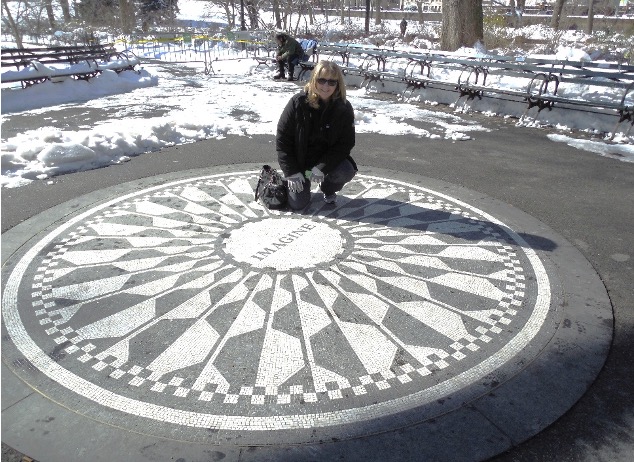
He was an “honorary American” in my book, who never had legal citizenship but certainly had the love of millions of American citizens. Every year on his birthday and the anniversary of his death, fans arrive with flowers and candles at the Imagine Mosaic at Strawberry Fields in Central Park, to pay homage to him. And for all of this, I tip my hat to John and his efforts to stay in the Land of the Free. You are, and will always be loved, John.
Copyright notice- ©Shelley Germeaux 2026: This article is subject to copyright restrictions and may not be reproduced without the author’s permission.
Endnotes
[i] Gimme Some Truth, Jon Wiener, University of California Press, 1999, Introduction
[ii] Lennon Revealed, Larry Kane, (p126)
[iii] Lennon Revealed, Larry Kane, (p112-115)
[iv] Lennon Remembers, 1970 Roling Stone interviews with John Lennon and Yoko Ono, (p144)
[v] John Lennon vs. the USA, Leon Wildes, (p256), date of entry to U.S.
[vi] https://performingsongwriter.com/john-lennon-fbi-files/
[vii] https://www.imaginepeace.com/archives/24608
[viii] https://www.johnlennon.com/news/daytime-revolution/
[ix]https://www.kcrw.com/shows/press-play-with-madeleine-brand/stories/lennon-ono-mike-douglas-show
[x] https://faroutmagazine.co.uk/john-lennon-yoko-ono-fbi-surveillance-dick-cavett-show-video-1972/
[xi] https://www.johnlennon.com/music/albums/sometime-in-new-york-city-2/
[xii] https://law.justia.com/cases/federal/appellate-courts/F2/527/187/309916/
[xiii] Lennon, the Mobster and the Lawyer: The Untold Story, Jay Bergen (2022)
[xiv] Lennon Revealed, Larry Kane (p122)
[xv] John Lennon vs. the USA, Leon Wildes, (p168)
[xvi] Ibid (pg 197)
[xvii] Lennon Revealed, Larry Kane (p 124)








Always great to read your stuff Shelley
A wonderful piece of writing, Shelley! Today’s generation is surely missing a cultural figure such as John Lennon! There is much revisionism going on in today’s culture trying to minimize or scoff at his impact. I love his quote when he was finally given his green card and he was asked for a quote about what had transpired with the US government trying to throw him out of the country. He said, “TIME WOUNDS ALL HEELS.” Wordplay used to say that what goes around comes around and that whatever we do in life, whether good or bad, comes back to us in one way or another-Instant Karma! A Man for the ages! Thanks Shelley!
OH YES….that would have been a great comment to use in the article! Thanks for mentioning it! And thank you for your support over the years, it means alot to me to get your encouragement!